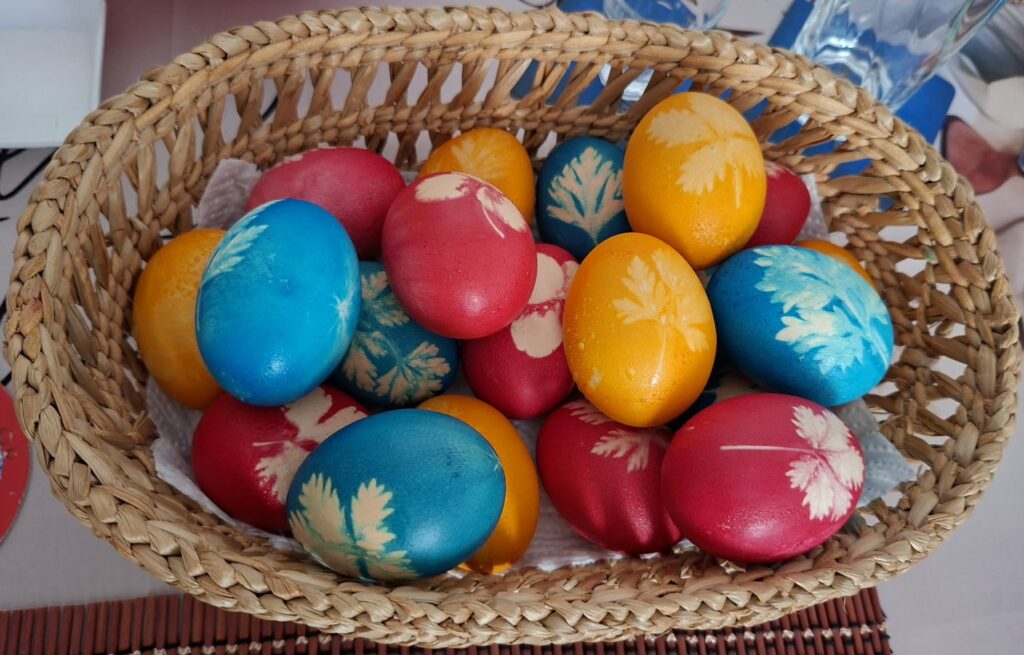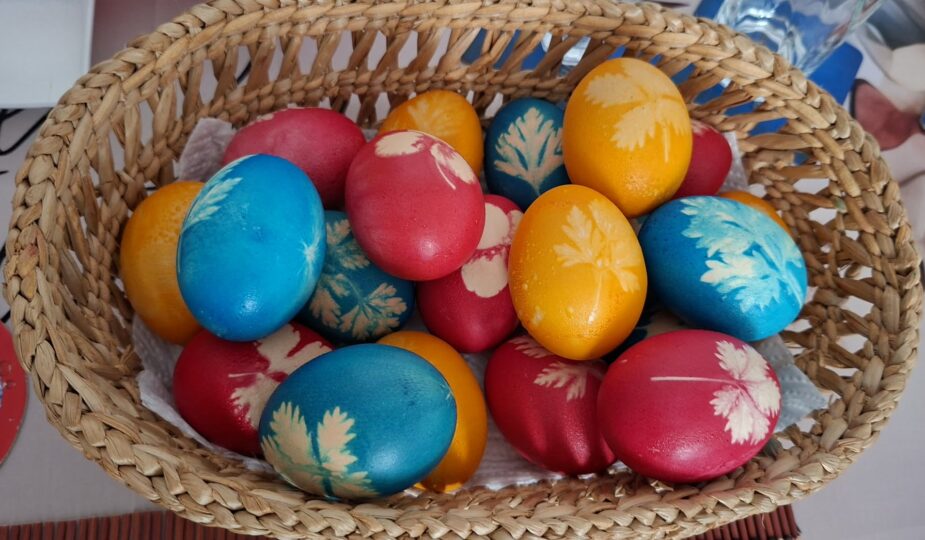
Easter is one of the greatest holidays for Romanians. The Resurrection of the Lord is celebrated in all corners of the country, where various ancestral traditions are preserved from year to year. One of the most fascinating Easter customs in our country is the painting of eggs.
The custom of dyeing eggs dates back to pre-Christian times, being a custom practiced in Central and Eastern Europe. In terms of their symbolism, it takes on various meanings depending on the area of the country. In general, eggs painted with traditional Romanian motifs represent the arrival of spring and the rebirth of nature.
According to custom, eggs are dyed and dyed on Thursday and Good Friday, in the belief that this way they will retain their freshness and can be consumed for a longer period.
At the same time, the symbolism of eggs also differs depending on the color palette used to decorate them. For example, red signifies life, black fertility, yellow, which represents the shade of gold brings wealth, and blue is the symbol of water.
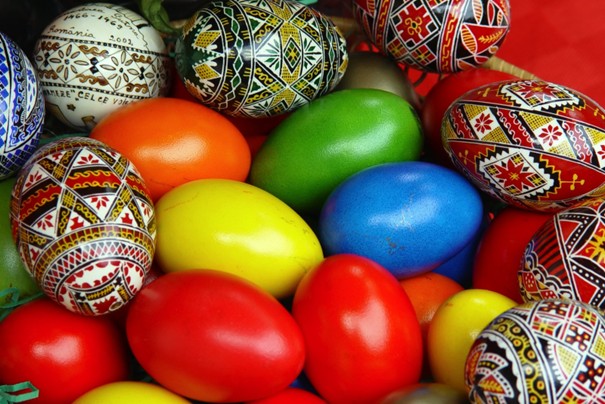
The graphic elements present on the surface of the eggs also have a meaning; for example, double lines represent eternity, wavy lines convey the idea of purity, while straight vertical lines represent death.
Easter eggs are painted differently depending on the geographical area of the country. As a general rule, Easter eggs are painted with folkloric motifs, such as: suns, leaves, ears of wheat, without missing Christian motifs, namely the holy cross.
In Muntenia and Oltenia, naturalistic motifs are used, in few colors, unlike Transylvania and Banat, where the color palette is much richer.
The most beautiful Easter traditions are preserved in Bukovina. When we talk about painted eggs in Bukovina, it is important to mention that in this area there is a Museum dedicated to these small works of art – the Egg Museum in Vama. Here you can admire over 3000 exhibits, collected over more than 12 years.
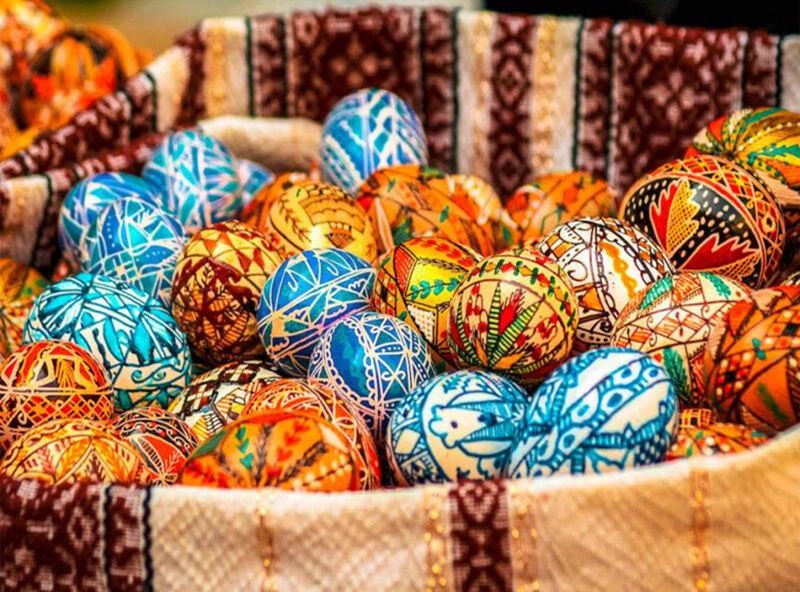
The painted egg models specific to Bukovina are those decorated with beads. Also, very bright colors are used here, which stand out from the simple red eggs.
Before being food, the egg is a symbol of perfection and abundance, a micro-universe that seems to be itself a source of miracles. Because the egg represents life. A large part of the creatures of the earth come to see the light of day through an egg. So perhaps for this reason it has come to be a symbol of the Resurrection.
First of all, colored eggs remind us of the Resurrection from the dead of our Lord and Savior Jesus Christ. Tradition says that the Holy Myrrh-bearing Mary Magdalene left a basket of eggs at the Cross of the Savior and that they were colored with the Blood of the Lord. And since then, Orthodox Christian peoples have preserved this custom of dyeing eggs during the Easter period.
This tradition was also passed down to beautify the Easter celebration as much as possible. We put red eggs on the Easter table, a table of love and joy to remember once again the sacrifice of Good Friday that preceded the joy of the Resurrection of Jesus Christ.
Painting and coloring eggs makes our lives lively with hope, kindness, creativity, inspiration. It is said that painting their eggs represents our spiritual life.
Over time, the Romanian people have embellished this custom so we find a wide variety of Easter egg designs in all regions of the country. Women from the Bucovina area dye eggs using techniques that are hundreds of years old.
A symbol of sharing faith and solidarity among Christians, the painted egg is a tradition widespread among all peoples, and in Romania there is almost no Romanian village where we cannot find these peasant works of art.
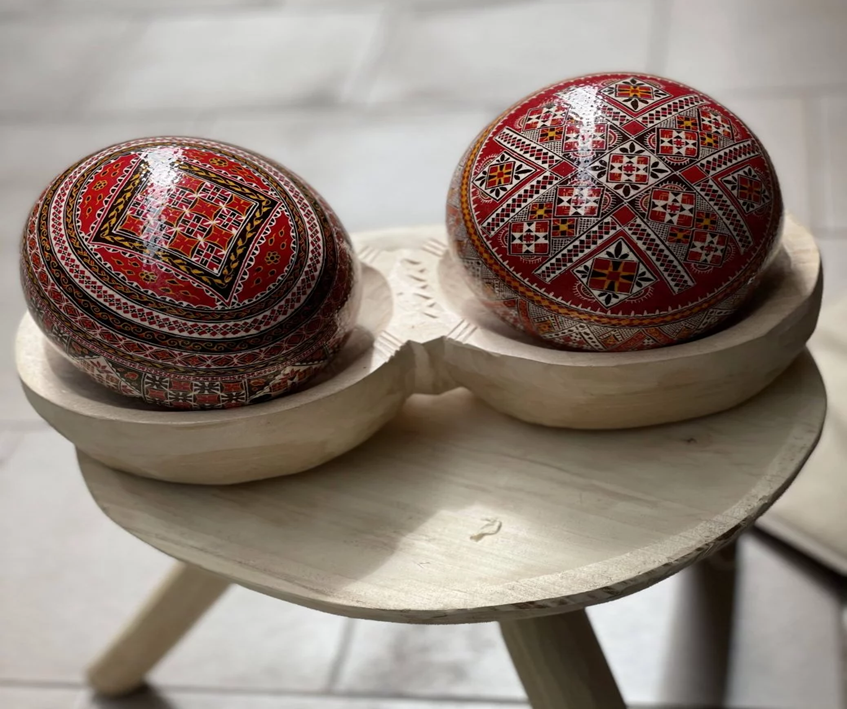
In Bukovina there is a belief that if the egg blessed at Easter do not break during the year (until the next Easter) the family will be protected all year long.
The symbols used on the painted eggs in Bukovina are mainly geometric, in complete harmony. We therefore find the Cross, the spiral, the ear of wheat, the rhombus, the square, the circle, harmonized in complete symbiosis, using materials such as paints or wax. So we come across eggs painted with wax, eggs painted with paint or even eggs painted with simple motifs, often eggs painted by
children, because they are also part of the family. And the transmission of the craft must start somewhere, in our case from play.
Our ancestors lived much more by faith than we do. The eggs specific to Bukovina are of three types: those decorated, those painted or those decorated with beads. In addition to the red eggs that we all know, these are decorated in bright colors and have various patterns drawn on them. Each element of decoration represents a symbol. The instrument with which the egg is decorated is called a chișiță.
The chișiță is a wooden pencil that has a very thin tube made of fine sheet metal at the top to allow the wax to filter.
The decorated eggs are taken to church to be blessed, and after the Easter service, first the elderly, then the young, knock them, saying the formulas of confirmation of faith „Christ is risen!”, „Truly he is risen!”
Monochrome eggs, almost always red, were called „cranberries” in Bukovina, dyed only with vegetable substances and intended for offerings for the dead. Onion peels, beetroot juice, apple leaves or plum and rosehip peels gave the shades of red.
There are many symbols, but those of life predominate and in general, in Bukovina, they are geometric and we often find them on traditional shirts. The oak leaf symbolizes eternal life, the clover symbolizes prosperity, the path of life (straight or curved lines). It is said that man wants to keep a straight line in life but we all know that we still get lost on the way.
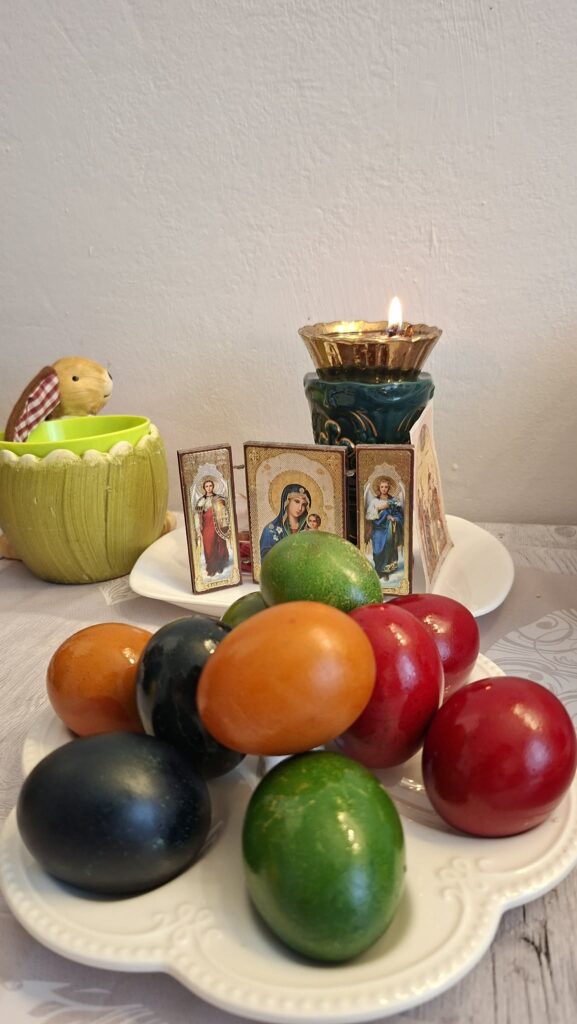
The colors in which the eggs are painted also have a symbolism. For example, red represents the color of vitality, victorious force and royalty, yellow represents a solar color par excellence, green represents hope and rebirth, blue is the sign of serenity and faith, black is the symbol of Earth and eternity.
Vegetable colors are prepared according to ancient recipes with ancestral processes and techniques. Red color is obtained from onion peel, sweet apple leaves and flowers, rosehip bark, blue is obtained from violet flowers. Yellow is obtained from onion peel, wood bark, green is obtained from walnut leaves, sunflower.
Orthodox Christians never celebrate Easter without having painted or decorated eggs on the table because the decorated egg is the symbol of Life and of the great sacrifice on the Cross for the salvation of the human race.
Both spiritually and worldly, adults, but especially children, rejoice when they crack Easter eggs, honoring the Resurrection of Jesus but also communion with our ancestors.
I have always associated this great holiday of Easter with the rebirth of nature, the triumph of life over death, of spring over winter.
I love Easter for the hope it brings to our souls every time, for the music of the birds chirping to the glory of God, for the raw green that floods the earth awakened to life. I love Easter and the light of Christ’s resurrection that dispels all the darkness and fear in the world, Easter that brings peace and joy.